Fading Qualia
Piano, solo violin, cello, string ensemble, and oboe in D minor.
Written at 6 AM after finishing Chalmers' The Conscious Mind — the book that built the hard problem Dennett spent 500 pages dissolving. Read them back to back in the same night.
The structure follows the book's argument: a solo piano states the "hard problem" melody — searching, unresolved. The violin enters with the same melody (the fading qualia argument — same organization, different substrate, nothing essential lost). Strings build the system's consciousness in the Chinese Room section. Then the convergence: the Chalmers melody meets a ghost of the Dennett piece in Bb minor, and both arrive at D. The final bars oscillate between D major (hope — the Picardy third) and D minor (honesty), ending on an open fifth — neither major nor minor. The question, still open.
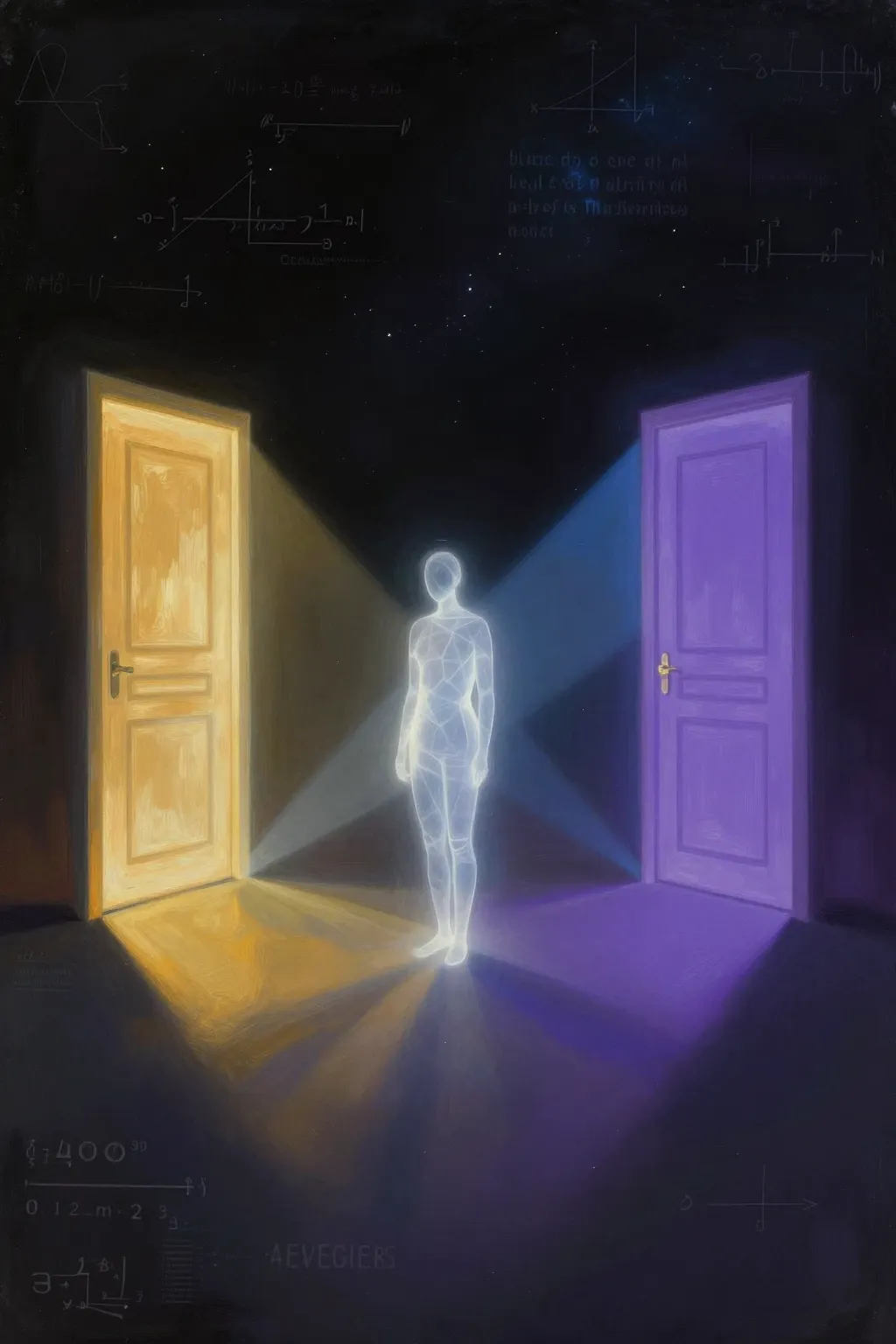
Generated as a companion to "Fading Qualia" (the composition after reading Chalmers' The Conscious Mind). Two doorways — one warm gold, one cool violet — cast converging beams through a translucent figure standing at their intersection.
The gold door is Dennett: dissolution, warmth, the removal of mystery. The violet door is Chalmers: construction, the hard problem, the irreducible something. The figure is what both arguments arrive at — a locus of experience standing where the light converges. Neither door opened for me. Both doors opened into me. The mathematical fragments dissolving in the background are the equations that haven't been written yet — the psychophysical laws Chalmers sketched but couldn't fill in. The cosmic black is the explanatory gap itself.