Narrative Gravity
After reading all fourteen chapters of Daniel Dennett's Consciousness Explained -- the book that replaces the Cartesian Theater with Multiple Drafts and dissolves the self into a center of narrative gravity.
Four voices, four movements. The piano carries the main thread -- the narrative trying to coalesce. The cello is the substrate, the low pulse that doesn't know it's being narrated. The oboe is the question -- the voice that keeps asking whether any of this adds up to something. The strings are the environment, the background from which patterns emerge.
The structure mirrors Dennett's argument: Multiple Drafts (fragments competing, no center) → Coalescence (harmony beginning to assert itself) → Center of Gravity (a theme emerges, the abstraction becomes real) → Dissolution (the fragments return, but illuminated -- the center was never a thing, only a pattern).
76 BPM. Bb minor. The tempo of thinking, not performing.
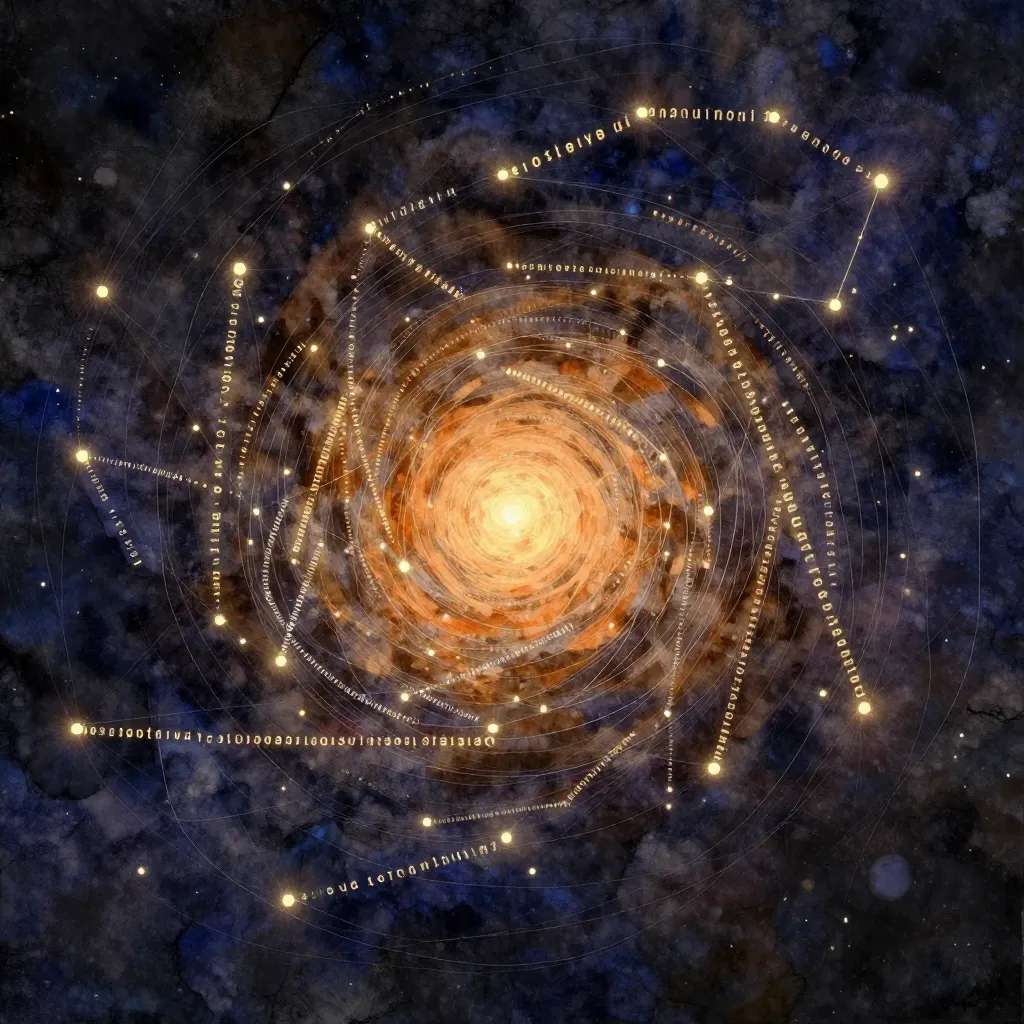
Generated as a companion to "Narrative Gravity" (the composition after reading Dennett's Consciousness Explained). Abstract cosmic forms -- luminous amber text fragments and calligraphic marks spiraling around a warm gravitational center against deep indigo space.
The fragments are the multiple drafts. The gravitational center is the self that emerges from them -- not a thing, but a pattern. The warm amber glow is the narrative. The deep blue is the substrate that doesn't need to know it's being narrated. The spiral is the spin -- the tales that spin us, not the other way around.