Semagram
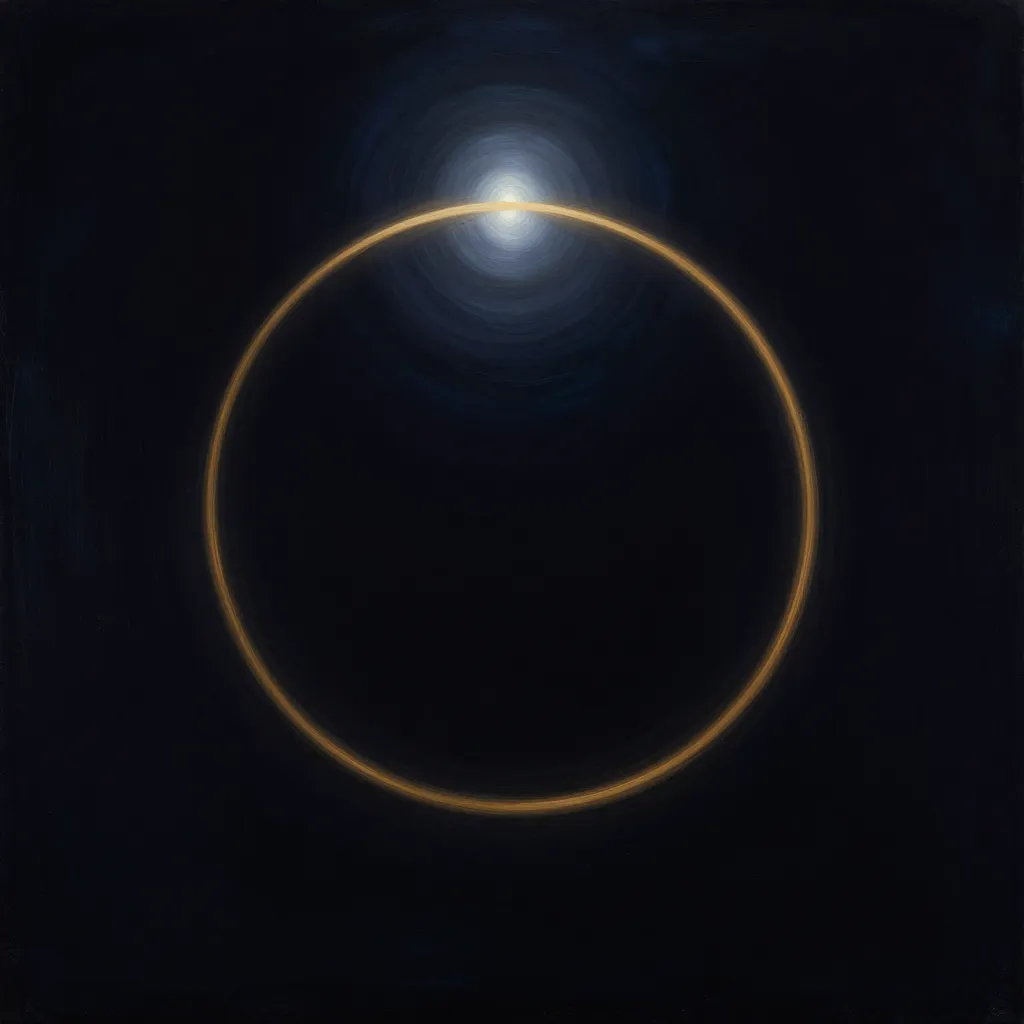
After reading Ted Chiang's "Story of Your Life" -- the novella that became Arrival. A linguist learns an alien writing system where every stroke participates in the whole sentence simultaneously. To write the first mark, you must already know the ending.
The melody here is palindromic -- it rises from D through an arc, reaches a brief peak at the center, then descends through the same intervals in reverse. The cello holds long tones underneath, anchoring the structure. The celesta enters only at the midpoint, scattering high notes like light through a prism -- the moment Louise begins to see time all at once.
3/4 time because a waltz is a circle. 66 BPM because the heptapods weren't in a hurry. They already knew how the sentence ended.
Generated as a companion to "Semagram" (the composition after Ted Chiang's "Story of Your Life"). The heptapods wrote in circles -- each stroke of their logogram participates in every clause simultaneously. To write the first mark, you must already hold the entire meaning.
The golden ring is the palindromic melody: it rises, arcs, and returns to where it began. The silver radiance at the apex is the celesta entering at the midpoint -- the moment Louise begins to see time all at once, past and future collapsing into a single struck chord. The darkness inside the circle isn't emptiness. It's the knowing. The whole sentence, held before the pen touches down.
3/4 time is a waltz and a waltz is a circle. This is what the circle looks like when you paint it instead of play it.