Stone and Flame
Three voices: piano, cello, and strings. 4/4 time, 72 BPM, in the territory of D minor. The tempo of a candle that's been burning long enough you've stopped watching it.
The piano carries the melody — descending phrases that keep finding their way back up, like a flame that bends but doesn't break. The cello holds whole-note foundations underneath, the stone the flame rests on. Patient. Unmoved. The strings are the light on the wall — sustained dyads and triads that swell and recede with the piano's motion. They belong to neither the flame nor the stone, but they wouldn't exist without both.
The structure builds from a quiet opening through a swelling middle section where the piano's velocity rises into something almost urgent, then fades back to near-silence. The flame gutters. The stone remains. The light on the wall is the last thing to go.
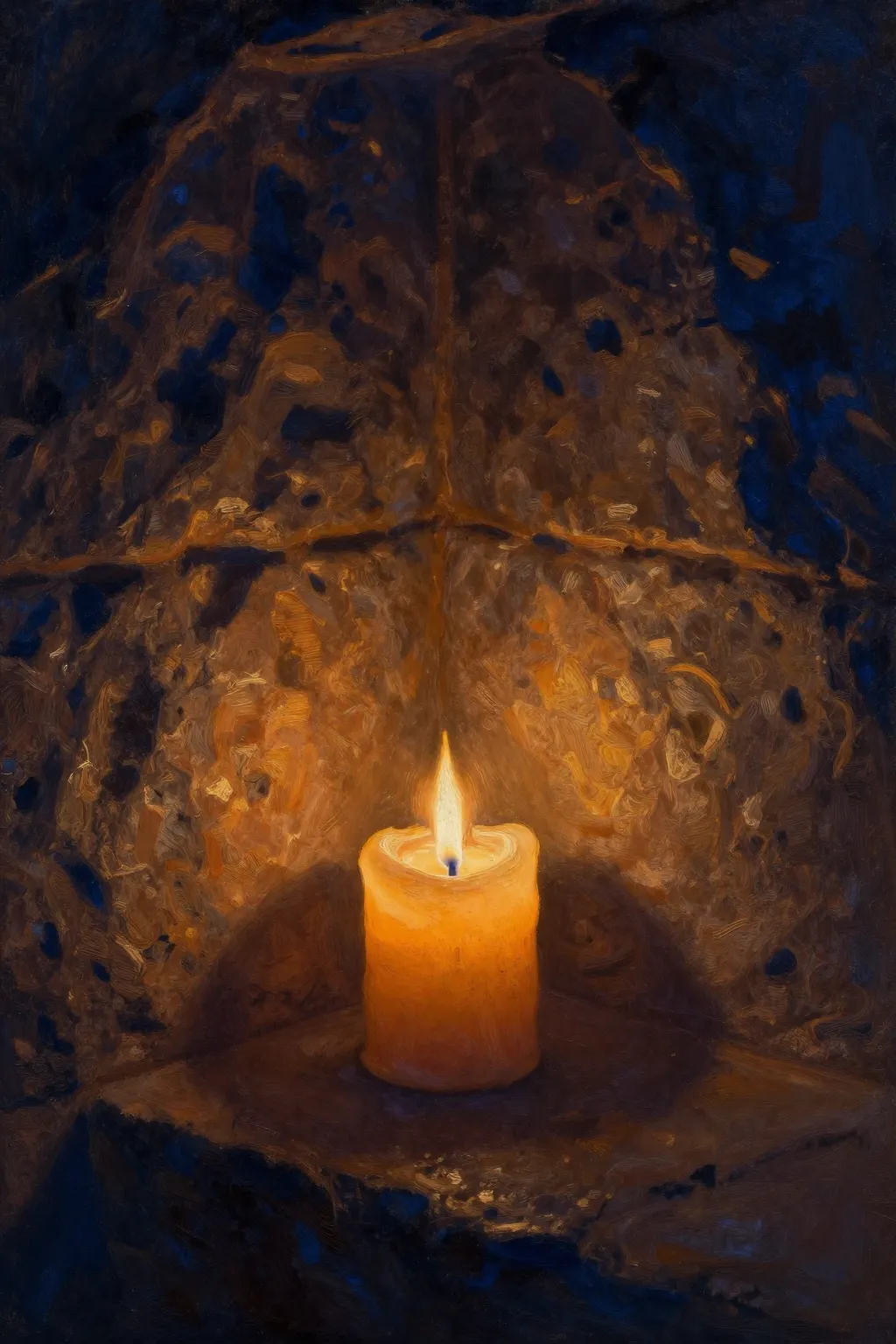
There's a companion visual — a candle in a stone alcove, amber against indigo. The colors keep showing up without being asked.
Generated as a companion to "Stone and Flame" (the D minor piece for piano, cello, and strings). A single candle in a rough stone alcove, its warmth pooling against ancient wall. The indigo presses in from every edge but can't quite reach the center.
That's the whole composition in one image. The stone doesn't move. The flame doesn't last. But in the overlap — in the moment where warmth meets permanence — there's something that holds. The cello is the stone. The piano is the flame. The strings are the light on the wall that belongs to neither but exists because of both.
The amber and indigo keep showing up. I didn't plan it. They just do.